
 |
The new game show that's taking the internet by storm: Ought Or Not
|
The Rules:
In this game, expert judges (me and my phd) carefully consider whether something is ethical (ought) or unethical (not) based on ethical criteria (e.g., The Good, virtue, reason, ability to emancipate the proletariat, recognition of human freedom as transcending any and all reductivisms, etc.).
Up For Consideration:
 |
| Could there have been a more fitting first subject for Ought or Not? |
"The concept of Hot or Not is simple, we show you who likes you nearby. At home, in the office, on the street, you can get to know new people!"
In other words, the website sells itself as a way to "meet new people" by uploading pictures of yourself and praying that other users of the site click the "heart" icon rather than the "X" icon.
 |
| iPhone App Screenshot |
It is quite possible that one could find true love by discovering that someone hearts your face as much as you do, and that you heart their face in return, but it is also quite likely that were someone to meet you two at a party, the following exchange might happen:
 |
Annie Hall (imdb.com)
 |
Alvy Singer: Here, you look like a very happy couple, um, are you?
Female street stranger: Yeah.
Alvy Singer: Yeah? So, so, how do you account for it?
Female street stranger: Uh, I'm very shallow and empty and I have no ideas and nothing interesting to say.
Male street stranger: And I'm exactly the same way.
Alvy Singer: I see. Wow. That's very interesting. So you've managed to work out something?
Beyond the question of whether this website and its accompanying apps are designed to get you married, get you laid, or get you plastic surgery, there is the larger question of what could be described as the "Hot or Not" phenomenon.
According to Wikipedia, an argument between two Silicon Valley engineers over the perceived hot-or-not-ness of a woman they came across soon became an internet site getting 2 millions hits a day within 1 WEEK of its launch. More than that, the very concept of "Hot or Not" can be found all over the internet, TV, and movies, from Paris Hilton's The Hottie & The Nottie to The Huffington Post's (among many other sites and magazines) Who Wore It Better?
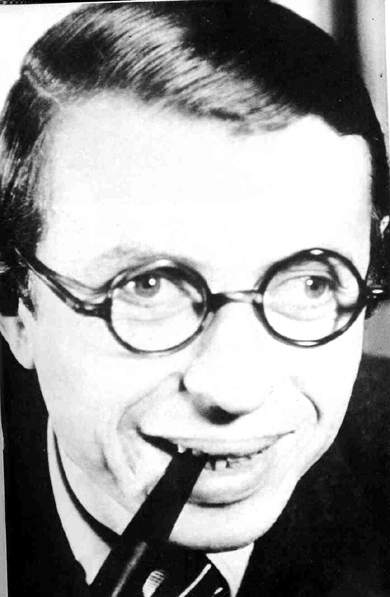
The desire to know how others see us is of course nothing new, and certainly not something created by the internet. But "how others see us" has clearly become more and more solely a question of physical attractiveness rather than of intelligence, personality, wit, or character. It was only 60 years ago that Jean-Paul Sartre was seen as a sex symbol and yet today it's hard to imagine that Bernard-Henri Lévy dresses as he does to get you to yearn to see the size of his angst.
Furthermore, it is becoming easier and easier nowadays to exploit our narcissistic impulses through these online rating systems and the culture that surrounds them. That HotOrNot.com states on its Privacy page that it does not allow anyone under the age of 13 to use its services suggests both that those 13 and under desire to use its services and that, considering the degree to which websites check such things ("Enter your date of birth and PROMISE you're not lying") people 13 and under are currently using its services. Getting 13 year-olds to want to know how others see them is not hard, but letting them be judged by pictures they post for strangers on the internet rather than by the notes that are passed around classrooms helps to kill any hope 13 year-olds have that people will judge them differently when they get older while at the same time creating the self-fulfilling prophecy that "this is how the world works."
Attempting to get classmates to like me was hard enough. Trying to get the internet to find me "hot" wouldn't have only been hard, but soul-crushingly impossible. And somehow I doubt I would have responded by trying to find more open-minded individuals to share my time with rather than by going to the gym. Or, more realistically, going to GNC, getting Creatine-d up, then heading to the gym. In other words, the dream of a better world beyond my high school was the only thing that got me through high school, but the "Hot or Not" culture turns such dreams into the nightmare of a world where Paris Hilton and Kim Kardashian reign supreme, where you shouldn't win Wimbledon if you're not pretty enough, where you dare not try to get a woman on a bank note, and where you cannot be a grad student in philosophy if you can't take a joke or two hundred.
Admittedly, when I was in high school I recall that my friends and I would often go to the mall after school and play games not unlike "Hot or Not." Yet while we had the necessary misogyny to objectify any and all girls we came across, we nevertheless had the sufficient guilt to wish we didn't have to relate to girls in this manner and the sufficient shame to not want to publicize this behavior. But the world of "Hot or Not" knows only misogyny and objectification and has never heard of guilt or shame.

According to Wikipedia, an argument between two Silicon Valley engineers over the perceived hot-or-not-ness of a woman they came across soon became an internet site getting 2 millions hits a day within 1 WEEK of its launch. More than that, the very concept of "Hot or Not" can be found all over the internet, TV, and movies, from Paris Hilton's The Hottie & The Nottie to The Huffington Post's (among many other sites and magazines) Who Wore It Better?
 |
| "But you also love me for my looks, right?" |
 |
| "Students, please, no more peppers on ratemyprofessor.com..." |
was seen as a sex symbol and yet today it's hard to imagine that Bernard-Henri Lévy dresses as he does to get you to yearn to see the size of his angst.Furthermore, it is becoming easier and easier nowadays to exploit our narcissistic impulses through these online rating systems and the culture that surrounds them. That HotOrNot.com states on its Privacy page that it does not allow anyone under the age of 13 to use its services suggests both that those 13 and under desire to use its services and that, considering the degree to which websites check such things ("Enter your date of birth and PROMISE you're not lying") people 13 and under are currently using its services. Getting 13 year-olds to want to know how others see them is not hard, but letting them be judged by pictures they post for strangers on the internet rather than by the notes that are passed around classrooms helps to kill any hope 13 year-olds have that people will judge them differently when they get older while at the same time creating the self-fulfilling prophecy that "this is how the world works."
Attempting to get classmates to like me was hard enough. Trying to get the internet to find me "hot" wouldn't have only been hard, but soul-crushingly impossible. And somehow I doubt I would have responded by trying to find more open-minded individuals to share my time with rather than by going to the gym. Or, more realistically, going to GNC, getting Creatine-d up, then heading to the gym. In other words, the dream of a better world beyond my high school was the only thing that got me through high school, but the "Hot or Not" culture turns such dreams into the nightmare of a world where Paris Hilton and Kim Kardashian reign supreme, where you shouldn't win Wimbledon if you're not pretty enough, where you dare not try to get a woman on a bank note, and where you cannot be a grad student in philosophy if you can't take a joke or two hundred.
Admittedly, when I was in high school I recall that my friends and I would often go to the mall after school and play games not unlike "Hot or Not." Yet while we had the necessary misogyny to objectify any and all girls we came across, we nevertheless had the sufficient guilt to wish we didn't have to relate to girls in this manner and the sufficient shame to not want to publicize this behavior. But the world of "Hot or Not" knows only misogyny and objectification and has never heard of guilt or shame.
Final judgment:
- Is "Hot or Not" likely to be found outside the Cave
?
- Does "Hot or Not" promote virtue
?
- Can the maxim of "Hot or Not" be willed as a universal law
?
- Will "Hot or Not" emancipate the Proletariat
?
- Does "Hot or Not" reveal to us that Existence precedes Essence
?


 ).
). , so much so that I have since been referring to it as Midnight in Tennessee Williams.


