
 |
| This is a repost. But really, who cares, right? |
If Humans are Trusting Beings, What Does it Mean That We Have Become So Distrusting?
In my Introduction to Global Peace Studies class I recently assigned my students Noam Chomsky’s talk The Evil Scourge of Terrorism, wherein he lists crime after crime committed by the United States government—a war of terror in the name of “The War on Terror” that stretched from George W. Bush back to the Kennedy administration. My students, as often happens, took the article at face value and were shocked at the atrocities Chomsky listed. Yet when I performed my professorly duties of playing devil’s advocate and asked my students to consider how Bush and the others might respond to these allegations, how they might deny any criminality and further demand proof of these charges, the students immediately did a 180 and either took the government’s side against Chomsky or threw their hands up impotently, commenting on how this was why they didn’t watch the News. In response I asked them to break up into groups and try to figure out how to deal with situations like this, situations where they didn’t know who to believe, and though they officially came up with ideas like “keep an open mind” and “focus on the facts,” their unanimous unofficial answer was: trust no one.
This attitude of distrust is not unique to my students. It
is hard not to look around classrooms, coffee shops, and computer screens
without seeing distrust everywhere. It is hard not to feel nowadays as though
anyone could claim anything about any issue or individual, and that these
claims would get retweeted, liked, and whatever Pinterest users do before
anyone could question the claim let alone bother to fact-check them. It is easy
of course to write this off as just a by-product of the Information Age, of our
having too much information without the ability to process it. But this answer
only reveals a further problem: we are aware that the Internet makes it harder
to know fact from fiction and yet we are becoming more and more dependent on
the Internet for our information. Is this the result of our unknowingly living
lives of contradiction, of preferring ease of use to the work of scrutiny, or
is this instead a manifestation of something else, of something deeper, of
something that the Internet has not instigated but rather has illuminated?

Trust and Distrust
When discussing the issue of trust with my students I often
begin by asking them if they think of themselves as trusting, to which they
almost always respond with a resounding “No.” Yet when I point out to them that
they sat down on chairs without first checking them for missing screws; that
they are sitting in a room full of strangers who they often have theirs back
to; that they are listening to me without ever having asked for proof that I am
the professor or that I even have a professor’s badge, they begin to realize
that they are perhaps more trusting than they realized. When I go on to point
out to them that such social conventions as shaking hands and clinking glasses
to begin meals originated as ways to check our “friends” for weapons or for
poison they further realize that trust goes deeper than what one believes and
disbelieves as it could be said instead that trust structures our everyday
lives. In other words, trust is fundamental to who we are.
For Aristotle, humans are social beings. But what does it
mean to be social if we are not first and foremost trusting beings? Why speak
if I do not trust that you’ll understand? Why congregate if I do not trust that
it is safe to do so? Why even get up in the morning if I do not trust that it
is in some way worth it? If therefore trust is so crucial to being human, then
what does it mean to not trust?
It is one thing to not believe someone or something, to
think that what someone says is not true or that what you see is fake, but it
is something altogether different to have not-believing as an attitude, as a
way of seeing the world. Indeed we cannot even imagine what it would be like to
take up such an attitude, and thus when someone does claim to have done so, as
Descartes famously did in his Meditations, it only takes a smart-ass, say a
Wittgenstein, to dispell any such deep skepticism by daring Descartes to put
his hand in the fire he claims to doubt will burn him.
Nonetheless there are those who, as Jean Améry famously put
it, have lost their “trust in the world.” The key difference between Descartes’
distrust and Améry’s is that whereas the former invented his distrust as a
method for dealing with credulity, the latter discovered his distrust while
being tortured by the Gestapo. If trust is part of who we are then it is only
by becoming who we are not that we can become distrustful. In other words, one
cannot choose to be distrustful, but one can be made to be distrustful, a
making that occurs in trauma.
If we are indeed distrustful today, then have we been
traumatized?
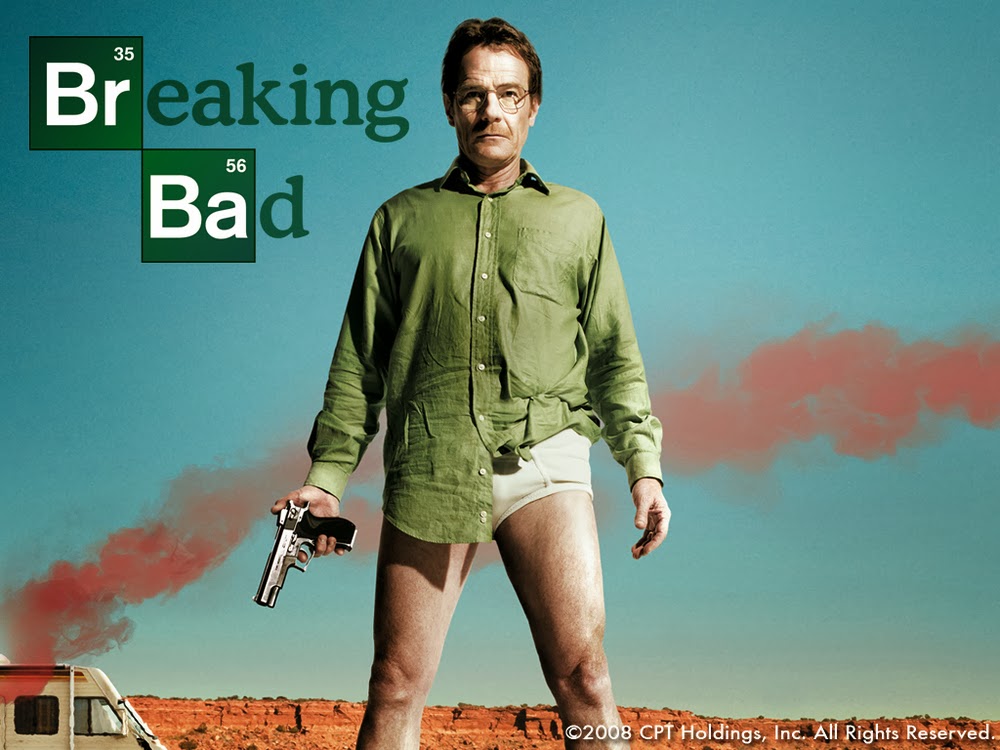 |
| He's the one who knocks, but why did you answer? |
Nihilism Porn
There were only so many times I could be told that Breaking Bad was the most amazing show on television before I finally overcame my lack
of desire to see Bryan Cranston as anything other than Hal/Tim Whatley and gave
the show a go. Though it took a similar process for me to finally start
watching The Wire, a show that I could not stop watching and immediately became
obsessed with, I found instead that I not only did not want to keep watching
Breaking Bad but that I had to force myself to go through the agony of watching
more. From the acting to the storyline to the cinematography I can certainly
see why so many would marvel at the show’s accomplishments, but at the same
time I cannot get over what to me appears to be the core of the show, a core
that I fear is actually what most of the audience is truly marveling at, the
core that I will refer to as Nihilism Porn.
From episode to episode Cranston’s Walter White “broke bad,”
but once the terminal cancer and fear for his family’s well-being was revealed
to be a red herring as motivation, the true motivation of his descent seemed
instead to be: I can, therefore I will. Likewise, the audience’s motivation for
watching seemed to be: He can, therefore I will. Walt can let a girl die, I can
watch. Walt can poison a child, I can watch. Walt can lie, I can watch. Walt
can torture his wife, I can watch. Yet this worked both ways, for the writers
of the show operated under a similar imperative: They can watch, therefore we
will give them a Walt worth watching. To see Hal kill, to see Whatley destroy,
is apparently what the audience wanted and it is definitely what the audience
got.
I bring this up not to suggest that we have become
distrustful because we have been traumatized by this television show, but
rather that the success of the show reveals just how untraumatized we are.
Death and destruction were not a cause for alarm but were a cause célèbre. If
anything, this seemed to be the show’s point: We want to see a nice sitcom dad
as a possible meth dealer, we want to see an annoying dentist as a possible
crime kingpin. Why do we want these things? Because we’re desensitized to
violence? Because we’re bored by sitcoms? Maybe it’s because we have not lost
our faith, but rather have re-discovered it, a faith in He did, therefore I
could.
I use “faith” here to underscore the possibility of seeing
something like a religious devotion inherent to the followers of Walter White,
the audience who has found faith in the idea of What Would Heisenberg Do? Much
like What Would Jesus Do?, followers of WWHD see mild-mannered Walter White
turned criminal mastermind Heisenberg as proof of another world, as proof that
no matter how dark and dreary reality may be, no matter how little there is to
be believe in in this world, there is nonetheless something to believe in, so
long as one has faith in another world.

Nihilistic Faith
“We can no longer conceal from ourselves what is expressed by all that willing which has taken its direction from the ascetic ideal: this hatred of the human, and even more of the animal, and more still of the material, this horror of the senses, of reason itself, this fear of happiness and beauty, this longing to get away from all appearance, change, becoming, death, wishing, from longing itself—all this means—let us dare to grasp it—a will to nothingness, an aversion to life, a rebellion against the most fundamental presuppositions of life; but it is and remains a will!… And, to repeat in conclusion what I said at the beginning: man would rather will nothingness than not will.” — Friedrich Nietzsche, On the Genealogy of Morals
Nietzsche is often seen as the philosopher of nihilism, so
it is only fitting that he should be the one best-suited to helping us to
connect these dots, to see the connection in our current culture of distrust
and in our love of nihilist porn. As was seen in the comparison to Améry, it is
not the case that we have been traumatized into becoming distrustful, but
rather that we are closer to Descartes, that we are closer to having willed our
distrust. But why would we do this?
If I may paraphrase Nietzsche here, a possible answer is
that we would rather trust nothingness than not trust. We cannot help but be
trustful beings, and yet, unlike Descartes, our response to our fear of
credulity is not to withhold judgment until our intellect can catch up to our
will, until we can be certain that we have found clear and distinct ideas, but
rather to dive into judgment and willfully spread, retweet, meme-ify gossip
faster than any intellect can process it.
It would therefore appear to be the case that it is not that
we are in a crisis of no longer knowing who to trust, but rather a crisis of no
longer caring about who is trustworthy.
So the next time you retweet some “breaking news,” ask
yourself: Do I know this to be true? Do I even care?


 ).
). , so much so that I have since been referring to it as Midnight in Tennessee Williams.


