Saturday, July 13, 2013

Military Suicide and PTSD

From BBC News: UK soldier and veteran suicides 'outstrip Afghan deaths':

Clinical psychologist Dr Claudia Herbert said PTSD is the body's "natural response" to distressing events. 
It can take years to emerge but is treatable if caught early. Symptoms include flashbacks, severe anxiety and depression. 
The number of soldiers with PTSD has more than doubled in the past three years among those who served in Afghanistan, according to MoD figures obtained via Panorama's FOI request.The MoD said 2.9% of serving soldiers develop PTSD, which is lower than the general population. 
But Dr Herbert said: "Post-traumatic stress disorder in itself should not lead to suicide." 
"PTSD is a condition that indicates something has deeply disturbed the system and is a warning that the system needs help and needs to regulate again." 
Nobody can be sure how many of the 21 soldiers and 29 veterans who took their own lives in 2012 were suffering from PTSD as the reasons for suicide are complex.
This is a rather indicative account of how PTSD is discussed in terms of military suicide in particular and the suffering of combatants in general.  As is clear, in terms of PTSD the combatant has been reduced to a "body," a "body" which is further reduced to something that operates not unlike a machine.  When the machine-body has its "system" "disturbed" then, like a factory wheel that has ceased to spin, the proper grease (PTSD medication) is applied.  When this doesn't work—and as the article's statistics make clear, this isn't working well—the onus of blame is put on the combatant's "system" rather than on this paradigmatic reductive approach to understanding suffering.  As I mentioned in my previous post, the suffering of combatants might best be understood instead through an approach that went beyond what happens on the battlefront to include what happens on the homefront as well.
Enhanced by Zemanta

Friday, July 12, 2013

Man of Steel and the Killing/Letting Die Distinction

      I have no idea where I found this, but
      thank you, whoever you are...
My favorite of
said chachkies
I am a huge Superman fan.  There are certainly bigger fans—I doubt I'd win a Supe off—but as a professor I have a duty to put a lot of chachkies on my desk, and almost all of mine are Superman-related.  This alone should justify, if not make necessary, this belated (and thus spoiler-heavy) review of Man of Steel (hereafter MoS).


Why Superman?  


Superman is the creation of Joe Siegel and Joel Shuster, two WWII refugees who turned their experiences of war and immigration into the creation known as Kal-El.  Spiderman might be a nerd-hero, Batman might be a neurosis-hero, but Superman is a Nietzsche-hero.

Though Superman is not in fact a direct descendent of Nietzsche's Übermensch, the two do share an existence that is epitomizes the transcendence of values (this will be more important when discussing a key scene in MoS shortly).  "Good" and "Evil"—creations of the human need to differentiate and denigrate—simply have no meaning for someone with the power to kill any enemy (this will also be important soon) or destroy the entire planet at any time.  To not only work at The Daily Planet, but to try to have an on-again/off-again relationship with Lois Lane, requires a constant awareness of one's powers, to constantly maintain oneself within self-imposed limits (self-imposed because of course there's no one else that could require he do otherwise).  Superman is thus the only superhero who exemplifies the Sartrean equation "freedom = responsibility."

Why not Man of Steel?

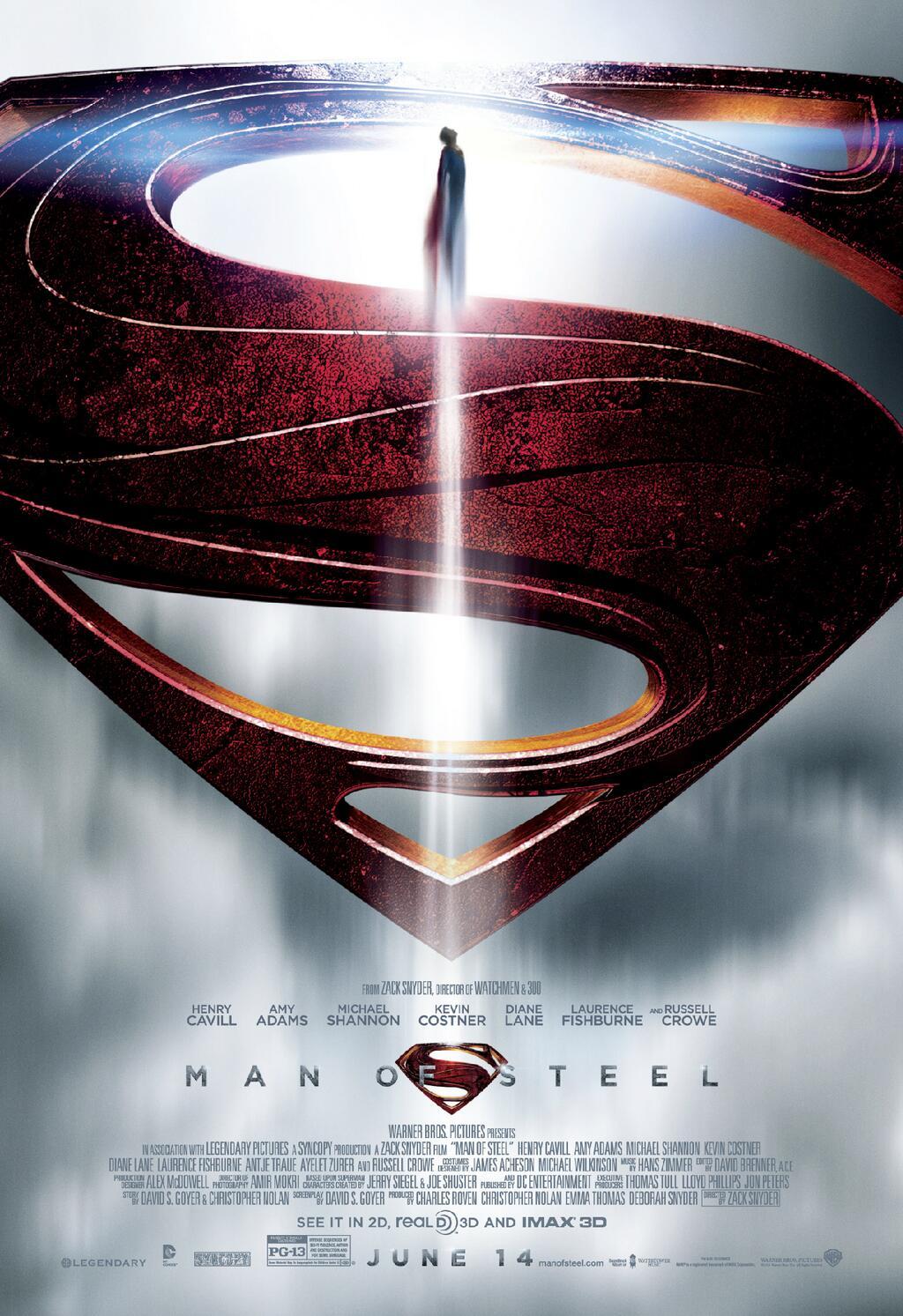
Even the poster hints at the
destruction of the legend...

I had high hopes for MoS.  Perhaps the height of these hopes was part of the problem, but I also had extremely high hopes for Superman Returns and I was actually one of the few people who was not disappointed by that version of Superman (the AVClub did a great job of reminding us of how good that movie actually was).  Now I should admit that I had had a bad day the day MoS was released, and so I also inflated my hopes by expecting it to turn my day around, but that's not all that unique either.

MoS started strong.  The key to any superhero movie, but a Superman movie first and foremost, is that it be awe-inspiring.  A comic book nerd watching a superhero movie should be like an art nerd watching Marina Abramovic stare at people.  Focusing on Krypton, having Russell Crowe do a Martin Brando impression, was a good way to start.  But when Crowe pulled an Avatar/Lord of the Rings and called for his trusty dinosaur companion to fly him to safety from Zod's minions, that was when I started to fear that Zack Snyder didn't think Superman was interesting enough to carry MoS.  This fear would not only be fully realized, but would be the ultimate undoing of MoS.

That all of the best Supe scenes were revealed in trailers and commercials (shirtless Supe on fire, Supe growing up in a Terrance Malick movie, Supe fist-flying) should have also been a sign that Henry Cavill was not the center of this movie, but Russell Crowe and Kevin Costner were.  Crowe turns Jor-El from super-scientist to bad-ass while Costner turns Jonathan Kent from dad-of-the-century to paranoiac-from-Hell.  It's one thing for Crowe vs. Zod to be made into an important plot point, and indeed their tete-a-tete is much more interesting than Superman vs. Zod (again, this shouldn't be the case in a Superman movie).  But Jonathan Kent should NOT, under any circumstances, tell his young son to watch him die in order to protect his secret.  Jonathan Kent is meant to be the voice of reason, the voice that, more than Jor-El, guides Clark Kent to become Superman, to become the superhero that all other superheroes look up to.  Jonathan Kent is NOT meant to scare Clark Kent so shitless that he flees his fate and passionlessly walks through scenes from Superman II (1980).  Moreover, the scene is idiotic.  Why would Clark agree to let his dad go back for the dog?  Why would Jonathan or Clark think that the people around them would ignore the tornado bearing down on them and focus on someone running—at a literally blinding speed—to save a dog?  This scene makes no sense other than to try to make Superman as dark as Christopher Nolan's Dark Knight.  Though of course, as I mentioned at the outset, Superman is always already dark.  He has to constantly, unendingly deal with his superpowers to prevent them from destroying the planet, something that he must also often experience as a temptation, a temptation that must drive him mad (as countless comics and cartoons have explored, but not yet 1 movie).  

This is what should have been explored in the all-unimportant scene of Clark Kent revealing himself to a priest in a church after Zod issues to Earth his alien-or-them ultimatum (on a positive note, the ultimatum scene was probably the best touch, as it reminded the viewer for the one and only time that the existence of an alien, let alone Superman, is important beyond the US).  For a priest to be told that aliens are among us, by that very alien, should be life-shattering, existentially-transformative news.  Instead this scene is pointlessly inserted solely to allow Snyder to smack the audience in the face with the Superman-as-Jesus allegory (by the way, did I mention that Superman was created by Jewish immigrants?) by framing Clark's head with Jesus's stained-glass window.  The priest should not have given Clark some throwaway, sort of meaningful priest-sounding line.  The priest should have been railing at the heavens, preparing for Armageddon, praying to Clark, anything that would have shown the stakes of what this scene SHOULD HAVE MEANT.  Nietzsche had more of an impact on religion than Superman walking into a church.  Ridiculous.

Killing vs. Letting Die


Last, but least, the ending.  Superman kills Zod.  The fight scenes leading up to it?  Superman and Zod just leveled Metropolis.  Thousands must have been killed by both of them.  Max Landis has already done a great job of going over the idea of what this should have meant to Superman, first and foremost that Superman should have killed Zod immediately rather than destroy the lives of so many to try to out-punch him.  I think Landis is onto something important about Superman's responsibility to kill, to sacrifice his values to save others.  I do not want to retread Landis's insights however, so instead I'll focus on something else that has been left out here.  For Superman to kill, and for this to be honored with nothing other than a scream, a sob, and then a drone joke, is despicable, and I don't mean just cinematically.  Superman's daily existence, as I've said now a couple of times, is premised on keeping himself in check, in not giving in to the ability to immediately end any fight with enemies by simply burning them alive.  To give in, to kill, should be what drives Superman to try to spin the Earth on its axis, to undo not only what he has done but time itself.

That none of this happened suggests that, contrary to biomedical ethics, we have reached a moment in history where killing and "letting die" are on equal footing.  Traditionally, letting die has been seen as ethically superior to killing on par with a lie of omission ("I was out") being seen as superior to a lie of commission ("I was saving orphans").  To try to show the irrationality of this position, James Rachels, in an essay entitled "Active and Passive Euthanasia", compared a vengeful heir-to-be letting a child heir found drowning in a bathroom tub die to this vengeful heir-to-be killing the child by drowning him.  The take away from this article is meant to be that it is not the method of death that should matter, but rather the intention that led to the death.

What I find more important to take away from this article however, and what connects it to MoS, is the idea that, as Rachels quotes from Dr. Anthony Shaw, it is harder on the medical staff to euthanize a child than it is on the parents of the euthanized child.  Relatedly, later in the article Rachels points out that whereas "letting die" is often presented in the news as an "angel of mercy" case, you don't hear about killing in the news outside of a murder case.  The killing/letting die distinction then is not about what is rational, but rather why we maintain an irrational distinction in the first place.  The answer is that this distinction is necessary to protect the identity of the doctor as a doctor and not as a murderer.  Dr. Kevorkian being known as "Dr. Death" is an ever-present reminder to doctors about what could happen if they are seen as killing a patient rather than letting a patient die, much as the My Lai massacre reminds soldiers about what could happen if they are seen as "baby killers" rather than veterans.

Superman has, in killing Zod, become a killer.  His identity has changed.  That Lois Lane knows what he did before he becomes Daily Planet-Clark Kent serves to instill in us the idea that Superman will now be forever known as a killer.  This is not troubling for Superman or for Lois Lane.  Killing is existential more than ethical, and yet MoS doesn't even give it the ethical weight it deserves (this lack is likewise found in the supposed discussions of killing found in "trolley car problems").  The answer that Clark Kent had not yet truly become Superman cannot serve as an answer to this problem, for in making Clark Kent a killer means that he will never truly become Superman.  Superman is the embodiment of the existential concern with the power to kill, Zack Snyder's "Superman" barely has the weight to be concerned with anything beyond franchise-building and marketing tie-ins (IHOP!).  If this is, as Christopher Nolan's Dark Knight aptly put it, the "hero we deserve," then we should all be very worried about what we do (and do not) embody as well.

Now go watch the real Superman...


Enhanced by Zemanta

Thursday, July 11, 2013

Aaron Hernandez, Walter Benjamin, and Rambo

Fans line up to return Hernandez jerseys (Boston.com)

According to a recent ESPN.com story, "EA Sports, the maker of the popular video games 'Madden NFL 25' and 'NCAA Football 14,' has opted to remove former New England Patriots tight end Aaron Hernandez from each game."  This story might initially make one think that the whole "innocent until proven guilty" judicial system that the United States operates with has been replaced by vigilante justice (though admittedly the vigilantism here is rather tame in historical terms).  However, while the world of our courts and the world of Playstations are ever drawing closer and closer to each other, there is still no law that requires video games companies—or NFL teams—to wait until justice has been done by the courts to begin to administer their own brand of justice.


What is of more importance here then is the question of "Why?"  What was it about Hernandez's alleged crime that has led the Patriots (admittedly, my NFL team) to remove him from the team and his jerseys along with him, and now EA Sports to remove him from the digital world?  An answer can perhaps be found in Walter Benjamin's famous essay "Critique of Violence" from 1921.  In this essay Benjamin distinguishes "mythic violence" from "divine violence," or the violence that is "lawmaking" from the violence that is "law-destroying":


If mythical violence is law-making, divine violence is law-destroying; if the former sets boundaries, the latter boundlessly destroys them; if mythical violence brings at once guilt and retribution, divine power only expiates; if the former threatens, the latter strikes; if the former is bloody, the latter is lethal without spilling blood. The legend of Niobe may be confronted, as an example of this violence, with God's judgment on the company of Korah. It strikes privileged Levites, strikes them without warning, without threat, and does not stop short of annihilation. (Reflections, 297).

Mythical violence, according to Benjamin, can be thought of in terms of the gods Artemis and Apollo destroying Niobe's family for her arrogance, or, in more recent terms, can also be thought of as what Keyser Söze did to those Hungarians who dared to attack his family in his absence.  In both cases we are meant to learn from this violence, to remember what happens to those who cross the gods or who cross Söze, and thus this memory serves as the inauguration of a law.  This form of law-creation operates then on a parallel with Nietzsche's story from the Genealogy of how medieval torture was used to instill "five or six 'I will not's'" into those humans who had not yet learned how to play nice with others, or in other words, to be a citizen.

Divine violence, on the other hand, is a violence that wipes away any trace of both the crime and the punishment.  Söze left one Hungarian alive to tell of what happened, but God, like EA Sports, leaves no such remainders or reminders.  As Benjamin explains, this violence is concerned with "expiation," an expiation aimed not at removing guilt from the sinner, but at removing law from the living.  Whereas law uses mythical violence as "bloody power over mere life for its own sake," God uses divine violence as "pure power over all life for the sake of the living."  Hence, "the first demands sacrifice, the second accepts it."  In other words, Artemis, Apollo, and Söze use violence in order to affirm their standing in the world, while God and EA Sports use violence in order to maintain the world.

So what world are the Patriots and now EA Sports trying to maintain?  A world where football and murder do not coincide.  By removing any trace of Aaron Hernandez, the NFL has been expiated of sin, or so the Patriots and EA Sports hope.  Their aim then is not to teach other football players or fans of football a lesson about the value of the real-world over and above the value of games, but rather to preserve games as free of the sins of the real-world.  Games therefore reign supreme, not the players, not the fans, and not our judicial system.

This is important, not necessarily because of what it means for Aaron Hernandez, but for what it reveals about the parallel situation regarding veterans and society (N.B. by "parallel" I'm not suggesting that veterans are murderers or alleged murderers, but rather that they are perhaps treated in a parallel fashion nonetheless).  As absurd as it may sound today, the first Rambo movie, First Blood (1982), is perhaps the best pop-culture example of what I am here referring to.  John Rambo, having just returned from Vietnam, having just failed to reconnect with who he
Go watch it, I'll wait...
believed to be the sole remaining member of his elite special forces unit, finds himself now lost.  Sheriff Teasle, as the local authority, or representative of divine power, comes across Rambo and offers to give him a lift.  In the ensuing conversation Teasle sizes up Rambo as someone who would find their small town of Hope to be too "boring" for "someone like him" and proceeds to thus do Rambo the favor of driving him through town, past all the restaurants Rambo was hoping to eat at, and across a bridge where he drops him off and advises him that there's a place to eat a few miles down the road.

This crossing of the bridge serves as a poignant metaphor for the treatment of not only returning Vietnam veterans, but of the now returning veterans from Iraq and Afghanistan.  Teasle does not arrest Rambo or try to kill Rambo (at least not initially) but simply drives him out of town, out of Hope, out of the "boring" world of peace, and back to the wilderness of what in my book I am calling exile.  The veteran is allowed to exist, but only so long as he exists somewhere else, somewhere far enough away to expiate the rest of us from the sins of war, sins therefore that we created but that they took upon themselves to live with.  When the veteran does not abide by these rules, he is then either attacked in an attempt to remind him that he is not above the rules (as happens to Rambo, as well as to Nicolas Cage's returning veteran in Con Air (1997)), or he is diagnosed as someone who is no longer capable of living in accordance with the rules (as happens whenever we diagnose someone with "war nerves," "solder's heart," "shell shock," "PTSD," or "TBI").  

Aaron Hernandez and Rambo thus serve to remind us, with the help of Walter Benjamin, that, like children, we do not clean up our messes, but rather pretend they simply do not exist.  As Nietzsche said, to forgive is not to forget, but rather to forget that one forgot.  We are currently in the process of forgetting Hernandez and veterans, and soon we will forget that we forgot, though of course with the aim of not forgiving them, but of forgiving ourselves.
Enhanced by Zemanta