Friday, June 26, 2015

My New Website


Ethicist For Hire is now live! There you can find:

I've also now got an Ethicist For Hire Facebook page. So go "like" that please. Or if that's too much to ask, you can always just drop some money in my tip jar...

Thursday, March 12, 2015

LSE Reviewed My Book


From Book Review: The Philosophy of War and Exile by Nolen Gertz:
Through a close critique of PTSD theory, just war theory, and Western ethics, combined with an empirical study of contemporary military training and torture methods, The Philosophy of War and Exile by Nolen Gertz is a compelling resource, writes Esther Adaire. Gertz’s intricate critique of the moral conundrums involved in war and peace makes evaluations that will resonate with those who are familiar with a range of theoretical perspectives. Continue reading at LSE Review of Books...
If you'd rather form your own opinion of my book and not be swayed by reviewers, you can buy a copy of it here.


Saturday, February 7, 2015

Martin Luther King Jr. and Continental Philosophy

Martin Luther King Jr.'s Diagram of Hegel's System
Dr. Martin Luther King Jr. was a great civil rights leader and champion of nonviolence. But beneath his views on race and oppression lies a philosophical schooling that began at least in graduate school, during which time he took courses at Boston University and Harvard on not only the History of Philosophy and the Philosophy of Religion, but also a yearlong seminar on Hegel.

Dr. King's list of courses, from The Papers of Martin Luther King, Jr., page 18.
While hints at his education in the history of philosophy can be found, for example, in his famous Letter from a Birmingham Jail (which references such philosophers as St. Augustine, Martin Buber, and Socrates), his having been a student in philosophy played a central role in making him the man we know today. In other words, Dr. King not only fought White America, but he did so by turning the ideas of dead white men against the oppressive practices of living white men.

As Dr. King wrote in his autobiography:
Just before [his advisor] Dr. Brightman's death, I began studying the philosophy of Hegel with him. This course proved to be both rewarding and stimulating. Although the course was mainly a study of Hegel's monumental work, Phenomenology of Mind, I spent my spare time reading his Philosophy of History and Philosophy of Right. There were points in Hegel's philosophy that I strongly disagreed with. For instance, his absolute idealism was rationally unsound to me because it tended to swallow up the many in the one. But there were other aspects of his thinking that I found stimulating. His contention that "truth is the whole" led me to a philosophical method of rational coherence. His analysis of the dialectical process, in spite of its shortcomings, helped me to see that growth comes through struggle.
In his Stride Toward Freedom, Dr. King argues, using Hegel, that rather than having to choose either passive acceptance of oppression or violently opposing it, there is a "third way":
The third way open to oppressed people in their quest for freedom is the way of nonviolent resistance. Like the synthesis in Hegelian philosophy, the principle of nonviolent resistance seeks to reconcile the truths of two opposites—acquiescence and violence—while avoiding the extremes and immoralities of both.
Thanks to the King Library and Archives in Atlanta, we can read hundreds of Dr. King's notes on not only Hegel, but also on Kant, Spinoza, Kierkegaard, Marx, and Nietzsche. Here are some samples:

Apparently Kant was not the only one awoken from a "dogmatic slumber"
A discussion of Existentialism
An analysis of Anxiety
The "two assumptions" that "are important in a study of Kierkegaard"
Happiness in Spinoza and Nietzsche
A quote from Nietzsche in a 1966 sermon 
An exam Dr. King gave his students at Morehouse College (#4 is about comparing and contrasting Gandhi and Marx)
An outline for a sermon on history, with references to Hegel, Marx, and Plotinus

Wednesday, February 4, 2015

What is 'Terrorism', and Why Can't People of Colour Be Victims of It?


From my latest post on ABC Religion and Ethics:
What is "terrorism"? What do we mean by describing an individual, a group, or an act as "terrorist"?
The most basic answer is that terrorism terrorizes, and thus any individual, group or act that causes others to feel terrified is terroristic in nature.
Such an answer is, of course, far too general to be of use, for then we would have to ask, for example, why the Charlie Hebdo deaths have been described in the media as caused by a "terror attack" while the deaths of Michael Brown and Eric Garner have not.
Continued...

Sunday, February 1, 2015

The Uber Bowl


Nietzsche's "Why I Am A Patriots Fan" (an excerpt):
"Like a last signpost to the other path, Belichick appeared, the most isolated and late-born man there has ever been, and in him the problem of the noble ideal as such made flesh—one might well ponder what kind of problem it is: Belichick, this synthesis of the inhuman and superhuman...”

Thursday, January 8, 2015

Jimi Heidegger


Are You Experience?
If you can just get your Being together
then come across to Time
We'll be towards death then we'll watch authenticity rise
from the bottom of anxiety
But first

Are You Experience?
Ah! Have you ever phenomenologized experience?
Well, I have...

If you like this psychedelic phenomenological poster, you can get a copy of it here or here.

If you really like this poster, you can show me here...

Saturday, January 3, 2015

A Crumby Kafka Christmas


What else is a Jew to do on Christmas but imagine the birth of Christ as an R. Crumb-inspired, Kafkaesque nightmare?

If you want to help me to do Part 2, or if you just like what I've done for Part 1, please subscribe to my Patreon page. As a Patreon subscriber you will also be able to see some of the earlier versions of this comic.

Monday, December 22, 2014

A Treatise on Holiday Politics


A Hanukkah gift from me and Spinoza.

And if you want to help me continue to become a disturber of religion, you can do so here:

Sunday, December 21, 2014

Tractatus Holiday-Philosophicus


A Hanukkah language-game from me and Wittgenstein.

And if you would like to take your turn in this language-game, you can do so here:

Saturday, December 20, 2014

Happy Cyborgmasukkah!


A Cyborgmasukkah gift from me and Donna Haraway.

And if you want to help start the Cyborgmasukkah revolution, you can do so here:

Friday, December 19, 2014

Happy Adornukkah!


A Hanukkah gift from me and from Adorno's classic Minima Menorah: Reflections on a Dreideled Life.

And if you want to get me something in return for this dialectical enlightenment, you can do so here:


Thursday, December 18, 2014

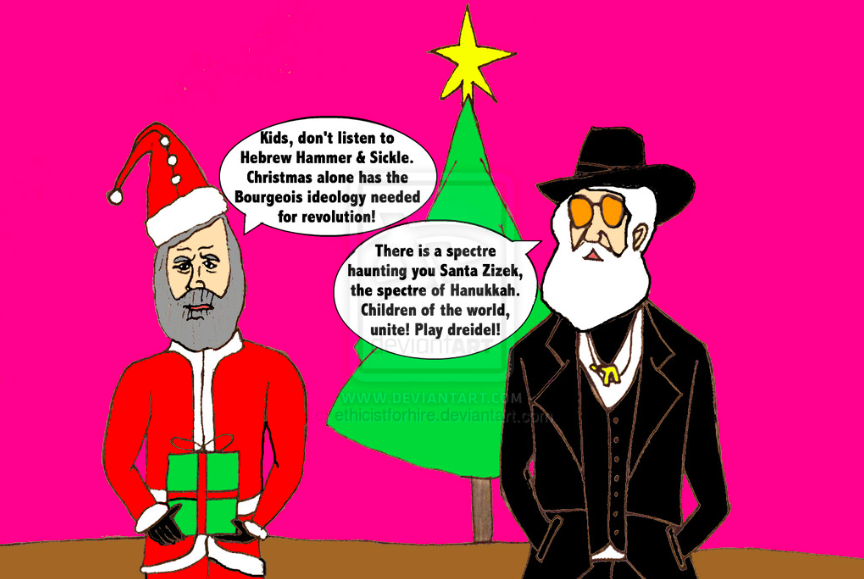
Santa Zizek vs. The Hebrew Hammer & Sickle


A Hanukkah gift from me, Zizek, and Marx, to you.

And if you want to get me a gift in return for my alienated labor, you can do so here:


Wednesday, December 17, 2014

Hanukkah Husserl


Here's another Hanukkah gift from me (and Husserl) to you.

And if you want to give me a gift in return, you can do so here:

Tuesday, December 16, 2014

Happy Hanukkah!


A Hanukkah gift from me, Freud, Benjamin, Arendt, Levinas, and Buber to you.

And if you want to give a gift back to me, you can do so here:


Thursday, November 20, 2014

#GamerGate - Is It About Misogyny or Ethical Journalism? Why Not Both?


For some, GamerGate is about the "ethics of gaming journalism," about the alleged collusion between video game developers and video game journalists, and about the response of gaming journalists and websites to such accusations. For others, GamerGate is about the misogynistic culture of video games, a culture that exists both in the sexist portrayal of women in video games and in the violent threats that have been made against women who have criticized this culture.

So what is GamerGate all about? Is it about the need for objectivity in gaming journalism, or is it about the need for equality in gaming culture?

While it has become something of a joke among those fighting for equality to argue that "it's actually about the ethics of gaming journalism," it is important to realize that these two sides of GamerGate need not be in opposition to each other, and could even be used to support each other.


Wednesday, November 19, 2014

World Philosophy Day 2014


For World Philosophy Day 2014, three of PLU's philosophy majors and I will be discussing GamerGate, Feminism, and the "Ethics of Gaming Journalism."

As the theme of this year's World Philosophy Day is "Social Transformations and Intercultural Dialogue," we will be attempting to start just such a dialogue between gamers and feminists.

For more information, see our event invitation here.

Tuesday, November 18, 2014

Visiting Professor Shines Light on Myths of Unmanned Warfare

From Southern News:
Vampires and Call of Duty were all used as subject matter in a lecture on war drones, but the only myth was that drone operators suffer less than combat soldiers. 
Visiting philosophy professor Dr. Nolen Gertz, of Pacific Lutheran University in Tacoma, Wash., addressed common misconceptions of drone operators in his lecture of, “The Myth of Unmanned Warfare: Drone Operators, Cyber Warriors, and Prosthetic Gods” Nov. 14 in Engelman C112. 
His lecture focused on how little people realize that although the drones are unmanned, those who operate the drones experience the operation more than a soldier on foot may experience it. Continued...
Find out more about the talk here.

Find out more about the book the talk is based on here.

Tuesday, October 21, 2014

The Myth of Unmanned Warfare - My Talk at SCSU on November 14th


I will be giving at a talk at Southern Connecticut State University on November 14th, based on my new book. 

If you're in the New Haven area, come check it out. If you're not, here's an abstract of what I'll be talking about:

President Obama's reliance on "unmanned warfare" in his War on Terror has been seen as a move to the opposite extreme of warfare from President Bush's use of torture in his War on Terror. However, the particular aim of this talk will be to show that—if we focus not on the questions of just cause, discrimination, and proportionality that are currently at the heart of such debates but instead focus on the question of what it means to be a drone pilot or cyberwarrior—torturers are not as removed from drone pilots and cyberwarriors as they may at first appear to be. Though drones are still a relatively new element of combat and cyberwarfare is much more in the planning than implementing stage, there is already evidence from drone pilots that although these tactics remove the combatant from the battlefront, the suffering remains the same. What this reveals therefore is that our ideas about what counts as “risk” for combatants needs to be rethought, particularly as some of the evidence that has started to appear indicates that drone pilots may even experience more suffering than do their traditional counterparts.

While the traditional view of responsibility as culpability leads directly to the “dream” of unmanned warfare, what my view of responsibility as capability reveals instead is that we must remove the dangerously mistaken idea that warfare in any form can be “unmanned.” Even if we consider the ultimate realization of this dream—autonomous unmanned warfare—it must be recognized that there will still be humans involved in the designing and programming of these autonomous robots, humans who will still have to face the consequences of what their designs and programs do. Whereas traditional combatants have their “band of brothers” to look to for support and have the insulating safety that distant wars can provide from feeling judged by noncombatants, these new non- traditional combatants have neither such support nor such distance. Instead, drone pilots, cyberwarriors, and robot engineers are judged by both combatants and noncombatants— by the traditional combatants who do not respect those who do not fight beside them, and by the noncombatants who they see regularly because their battlefront is the homefront. There is no such thing therefore as a “safe distance” from combat for combatants because the “distance” that is vital to both the experiences of combat and the suffering of combatants is not the physical distance from the enemy with which culpability operates. Rather what can now be seen is that this distance is existential, for this distance cannot be measured but only felt, and it is for this reason that our approaches to the suffering of combatants have not yet been able to properly help in closing this ever-widening gap between combatants and noncombatants.

Wednesday, October 15, 2014

Happy Birthday Nietzsche!

I couldn't think of what to get Nietzsche for his birthday today, so I thought I'd let him hammer away at Freud's ego instead...
As for how Nietzsche may have actually celebrated his birthday, I believe this excerpt from a letter of his from October 24th, 1864 to his mother and sister may give us a hint:
I received the box and am greatly pleased over it, especially the nice linen things and the beautiful music literature. Yesterday we enjoyed a most jolly afternoon. I danced fabulously.
In a letter to Georg Brandes on April 10, 1888, Nietzsche provides us with an idea of how he viewed his life, from the day he was born on:
Vita. I was born the 15th of October 1844, on the battlefield of Lützen. The first name I heard was that of Gustav Adolf. My ancestors were Polish noblemen (Niëzky). It seems the type is well preserved despite three German 'mothers.' In foreign countries I usually am considered a Pole; even this winter the roster of foreign visitors in Nice entered me comme Polonais. They tell me that my head may be found in the paintings of Matejko's. My grandmother belonged to the Schiller-Goethe circle in Weimar. Her brother became the successor of Herder in the office of Commissary-general of Weimar. I had the good fortune of having been a pupil at the venerable Schulpforta from where so many have gone forth who are of account in German literature (such as Klopstock, Fichte, Schlegel, Ranke and so on and so forth). [...] I was forced to give up my German citizenship since, as commissioned officer (mounted artillery) I would have been called up too often and disturbed in my academic activities. Nevertheless, I am familiar with two weapons, sabre and cannon, and, perhaps, even with a third one... Then, too, I am according to my instincts a brave animal, yes, a military one. The long resistance has somewhat exasperated my pride.—Am I a philosopher?—But what of it!...